Showing posts with label Alzheimer's. Show all posts

Saturday, November 2, 2019

2019 MAIA Review: Day Two

Highlights from MAIA on Friday, August 9, 2019.

I have a few notes that I haven't shared from the Twelfth Annual Mid-American Institute on Aging and Wellness (MAIA) held on the campus of University of Southern Indiana.

Attendees include members of the tristate region's healthcare organizations (including USI students, faculty, and staff member), family care partners (formerly called "caregivers"), and individuals of all ages from IN, KY, IL and beyond seeking to improve the quality of their life by learning more about wellness across the lifespan.

Many healthcare professionals attending earn CME credits (continuing medical education), but a good portion of those present are not healthcare professionals; they are community members who are pro-active about their physical, financial, social, and emotional health.

These are details about the second day of this event, which took place on Friday, August 9, 2019. Find details about the first day, Thursday August 8th, by following this link.

Ron Weatherford in USI's Carter Hall
As people made there way to Carter Hall, they had the opportunity to practice a few minutes of Tai Chi as directed by Ron Weatherford.

Published in 2014 and 2017.
The morning keynote address was delivered by journalist and author Greg O'Brien.

He gave an engaging speech about living with Younger-Onset Dementia. previously called Early Onset Dementia (EOD).

His work as a journalist gives him the ability to articulate a lot of emotions and concepts about living with this disease. His family heritage and personality gives him the ability to do so with a lot of wit and wisdom; he comes from a long line of animated storytellers.

For those seeking to learn more about O'Brien, he has a well-regarded book, On Pluto, which has been republished in 2017 in an expanded edition.


Friday, August 30, 2019

What They Had: Film Review

21 January 2018.
It took me two months to watch this What They Had (2018).

The film was neither too long nor too boring.

Quite the contrary.

It was very engaging, but it was also challenging.

Written and directed by Elizabeth Chomko, What They Had conveys the complexities a family faces when someone is living with dementia, the most prevalent form being Alzheimer's Disease.

This 2018 film (which in the US primarily showed at film festivals, such as Sundance) focuses on one family's response to Ruth, played by Blythe Danner.

Ruth is the matriarch and former nurse whose memory problems lead to her wandering--during a snow storm--from her Chicago home, which she shares with her husband, Norbert (played by Robert Forster). 

This is frightening enough when people wander in nice weather. However, Ruth has disappeared into the city during a snow storm.

This becomes a catalyst for the son, Nick, played by Michael Shannon, to put in motion a solution for his parents' age-related challenges. Nick does what he thinks is the most obvious, practical, and objective response to advanced age: place mother in an assisted living center.

Their father, Norbert, disagrees--vehemently.

Saturday, December 22, 2018

Race for the Mind: Book Review

Published December 1, 2017.
Daniel Gerard Welch draws on his decades' long experience working in the international pharmaceutical business to write this corporate thriller, Race for the Mind, published in December of 2017.

The book's "MacGuffin" is a drug being developed as a cure for Alzheimer's disease. Given the severity of the symptoms and the increasing prevalence of this disease, a lot of companies are hungry to be the one to manufacture and market this medicine.

The average person may not realize how complicated the process is for bringing a drug to market. It's not just the science and the patents; it's the personalities of the business people that can determine a lot about how a drug moves from a research lab to a pharmacy.

This novel has a number of characters, but Jack Callahan is the character with the most frequent and most sympathetic point of view. He's a business man who adopts various workplace assignments in an effort to get this drug--developed by scientist Dr. Win Lin to market.


Sunday, August 12, 2018

2018 MAIA Keynote and Plenary Speakers

MAIA 11th anniversary swag bag, program, and tee.
What Is MAIA?

For the last eleven years, the University of Southern Indiana in partnership with Southwestern Indiana Council on Aging & MORE! (the local Area Agency on Aging) has organized an inter-professional gerontology conference. This year, the conference ran August 9th and 10th with a pre-conference workshop on the 8th.


Located in Evansville, Indiana, this two-day event offers keynote and plenary speakers with national--if not international recognition. In addition, dozens of other presenters also offer great information about promoting wellness across the entire life span. 

The participants are local health care workers, university students, and members of the broader Tristate (IN, IL, KY) community.

Many healthcare professionals attending earn CME credits (continuing medical education), but a good portion of those present are not healthcare professionals; they are community members who are pro-active about their physical, financial, social, and emotional health.

Last week was the third time that I attended the Mid-America Institute on Aging and Wellness (MAIA). However, it was my first time serving as one of the organizers as a member of the Blue Shirts team. 

This gave me the opportunity to see the amount of work that goes on behind the scenes. I'm grateful for all that USI, SWIRCA, the sponsors, vendors, and all the presenters do in order to make this event informative and exhilarating. 

By looking at the program ahead of time, I had a chance to read more about all the presenters before they arrived. However, with six concurrent sessions happening three times a day for two days, it was impossible for me to attend all 36 sessions!

Let me first report some key details about the keynote and plenary speakers. (Details about the 2018 concurrent sessions are now available here.)

Wednesday, August 9, 2017

Teepa Snow at MAIA 2017

Snow explaining unmet needs at MAIA 2017.
I spent the bulk of today attending a pre-conference workshop on dementia care.

For the past year, I have been teaching gerontology classes part time in the College of Nursing and Heath Professions at University of Southern Indiana in Evansville, Indiana.

Each August, the university hosts an aging conference sponsored by local agencies and businesses that support healthy aging.

Read more about the Mid-American Institute on Aging & Wellness (MAIA) here.

The two-day conference is packed with speakers covering an array of topics about healthy aging and elder care.


Saturday, February 4, 2017

Motherhood: Lost and Found: Book Review

Published December 4, 2013.
Ann Campanella experienced a decade of tension about her mother's failing health and her difficulties carrying a baby full term, which she chronicles in her memoir, Motherhood: Lost and Found (2013).

As an award-winning poet, Campanella brings her creative abilities of insight and turn of phrase to her work.

She generously shares her tender feelings and insights about her mother and her pregnancies, which may serve as a great comfort to people facing one or both of these challenges.

At the start of her book, we watch as Campanella's mother grows increasingly distracted and emotional.

Her mother, Elizabeth (Betty) Williams, has trouble driving, keeping track of time, and remembering what city she's in. She even fails to recognize family members and grows more dependent on others to help her dress, eat, and use the bathroom.

But the changes to memory and bodily function are not the only symptoms of Alzheimer's Disease. Betty grows more emotional, alternating between being confused, angry, depressed, paranoid, and hurt.

In time, the doctor's describe Betty's symptoms as those consistent with Alzheimer's Disease.  While this does give the family some answers, a diagnosis of a disease with no cure doesn't remove the affiliated difficulties.


Sunday, September 27, 2015

I'll Be Me: Film Review

Released 24 October 2014.
After experiencing some difficulty with his memory for several years, Glen Campbell received a formal diagnosis of Alzheimer's Disease in 2011 at age 75.

About the same time as this diagnosis, Glen Campbell and his wife, Kim Campbell, invited a camera crew to film "behind the scenes."

The resulting documentary--Glen Campbell: I'll Be Me (2014)--is a tribute to this musical legend and an honest-yet-dignified view of the challenges of living with Alzheimer's Disease.

The documentary is filmed over about a year and a half; however, clips of performances over several decades are included as well.

The resulting documentary is a blend between a celebration Campbell's career and an exploration of how Alzheimer's affects a person's day-to-day life.

Thursday, August 6, 2015

The Theft of Memory: Book Review

Published 2 June 2015.
Jonathan Kozol, teacher, writer and activist for education reform, writes a compelling memoir about the years he and his father, Dr. Harry Kozol, spent together from 1994 to 2008.

The Theft of Memory: Losing My Father, One Day at a Time (2015) starts with the onset of Dr. Kozol's symptoms of Alzheimer's Disease and continue until his death at 102.

This dementia memoir distinguishes itself by being very academic in its approach.  

Both father and son are nationally recognized in their fields. Because this memoir reflects their professions, I suspect that readers will either love it or find it a bit too cerebral.
 

Sunday, May 24, 2015

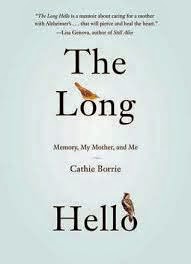
The Long Hello: Book Review

2nd Edition
Published 6 January 2015
All books are greater than the sum of their parts, but Cathie Borrie's The Long Hello: Memory, My Mother and Me really exceeds its boundaries in the most provoking ways.

I'm including her book in my list of memoirs about giving care to a family member with dementia.

However, the topics she covers and the genre she creates really differs from most books labeled "dementia memoirs."

Yes, Borrie details her relationship with her mother, Jo, over those seven years of caregiving.

Yes, like many other caregivers, she also reaches back to share memories from her mother's past, her own past and their shared experience.

Borrie is one of two children, and she's a child of divorce. Then her brother dies while still a teen. Borrie and her mother have sought for decades to survive these difficulties--even to thrive despite the sorrow, anger and pain inherent in these and other losses.

But Borrie writes a memoir in a way that does much, much more than preserve the past that she and her mother share.  Her mother's dementia sets the stage for Borrie to create a new relationship with her mother in the present. And while doing so, she creates a new person in herself.  


Sunday, March 1, 2015

The Leisure Seeker: Book Review

Published 27 January 2009
Take a trip on Route 66 with John and Ella Robina.

Michael Zadoorian's 2009 novel introduces readers to a mature couple driving from Chicago to LA--against the advice of their adult children and their doctors.

Nevertheless, these two are determined to have the time of their lives--one last, big adventure.  Well, maybe it's Ella who has decided since John is living with Alzheimer's Disease.

Ella has her own challenges as someone battling cancer. Her thinking is clear, but she's weak and can't drive. John still remembers how to drive, but almost everything else is fading away.

In the evenings, Ella jogs his memory by showing him slides of family events from days gone by: birthday parties, family reunions and even road trips when the kids were smaller.

As with other novels depicting dementia, there are passages about the function and value of memory:


Wednesday, December 17, 2014

Death In Slow Motion: Book Review

Published February 3, 2004
Eleanor Cooney admired her mother Mary Durant for being cool, stylish, intelligent and sophisticated.  Her mother's core personality traits were dismantled once Alzheimer's Disease started to take its toll.

In her memoir Death in Slow Motion  (2004), Cooney relays an enormous amount of detail regarding her mother's illness and its affect on Eleanor.  Despite Eleanor's best efforts, her mother was lonely, grieving, agitated, clingy, weepy, and complaining.

Interspersed between accounts of Mary's hardships are details about her interesting and sophisticated life during the decades prior.

Mary worked as a writer, editor and for a time a model. She lived in New York City for a time before residing for decades in Washington, Connecticut.


Thursday, December 11, 2014

Scar Tissue: Book Review

Published January 1, 1993
In 1993 Canadian author and politician Michael Ignatieff published a novel about a family's response to early onset dementia.  Scar Tissue was short listed for the Booker prize the following year.

Armed with this information, I decided to track down a copy of the book.  The narrator is one of two siblings adjusting to their mother's increased confusion.  The family also includes their father, a soil scientist and an immigrant from Russia. The mother is a painter.

The two brothers take different approaches to their mother's illness as influenced by their vocations.

The narrator is a philosopher. He saturates himself in images, emotions and theories. He mulls over the way dementia alters a sense of self, relationships and the ability to cast one's own life into a narrative.  He's on a never-ending quest for meaning.

His brother takes a more pragmatic approach by trying to identify the disease as it alters the material landscape of the brain.


Friday, November 7, 2014

Alz Awareness Month

Photo by Mitch.
A sponsored post on behalf of the Banner Alzheimer's Institute.

Modern medicine has enjoyed sweet success in preventing and treating a number of diseases.

People are living longer because there have been great strides in addressing heart disease, diabetes and even some cancers.

However, there is still no cure for Alzheimer's Disease  (AD), which is currently the 6th leading cause of death in the United States.

November is Alzheimer's Disease Awareness Month.  Consider wearing a purple ribbon!

It's a good time to focus on the prevalence of the disease and to learn about some ongoing work to prevent and cure AD in the near future.


Tuesday, October 21, 2014

Leaving Tinkertown: Book Review

Published August 15, 2013.
Even very focused memoirs end up tackling a variety of topics. This is true of Tanya Ward Goodman's 2013 memoir, Leaving Tinkertown.

I chose to read it because it fits in with a category of books that I have labeled "dementia memoirs."  I value reading about the challenges and opportunities of hanging onto a relationship affected by Alzheimer's or another form of dementia.

Goodman focuses her memoir around the six years that her father, Ross Ward, lived with early-onset Alzheimer's disease.

Her account discusses the symptoms, diagnosis, and progression through the major stages of the disease.  It serves as a valuable road map for caregivers.

Even though there are some similarities from one dementia memoir to another, each account shows how the journey is unique to each person and their loved ones.

In the pages of her memoir, Goodman introduces us to her nonconformist father who is driven to create. He has spent decades drawing, painting and sculpting.  He spent some time on the road, painting for carnivals.  However, his major work took form as a miniature town dubbed "Tinkertown."  Ward carved the inhabitants and set up a roadside museum that is still in operation in New Mexico, just north of Albuquerque.


I received a copy of Leaving Tinkertown from the author in exchange for a fair and honest review.

Thursday, June 5, 2014

Books about Dementia

Books by Mace/Rabins, Stettinius, & Shouse.
Even though my approach to aging is pretty broad, I have a persistent interest in cognition.

Not only do I read about healthy, normal, age-related changes to the brain, I also read about change caused by disease.

I am particularly interested in how dementia* changes a person's cognition and how caregivers respond.

[See this post about the terminology change favoring Neurocognitive Disorder over dementia.]

I have read more than two dozen books ranging from memoirs to reference books, and I hope to read many more. 

Here are some quick reviews of some of these books with links to longer reviews.  Most recent releases listed at the top of each category (aka reverse chronology). I heartily welcome recommendations of related titles in the comments section.

Last Updated March 2018 to add Carpenter's Healing Dementia (2017) and Agronin's The Dementia Caregiver (2016). 

Monday, May 19, 2014

The Story of My Father

Published June 8, 2004
For the last four years, I have been trying to learn more about Alzheimer's Disease.  As a retired English teacher, I frequently have people ask me about age-related changed to cognition.

Of course, people should talk to a neurologist for an expert opinion. Nevertheless, I am trying to learn what I can so that I can point people to resources.

More and more I am seeing the value in dementia memoirs, written by caregivers.  Although published in 2004, I recently got my hands on a copy of The Story of My Father by Sue Miller.

The author describes her relationship with her father in general and her need to respond to his Alzheimer's Disease in particular.


Wednesday, March 26, 2014

Re-imagining Alz: Dancing with Rose

Published May 31, 2007.
No doubt, living with dementia is a challenge. Whether caused by Alzheimer's Disease, vascular dementia or another cognition-altering malady, memory problems make it difficult to function in the world, difficult to relate to others.

I have frequently heard caregivers recommend Lauren Kessler's book Dancing with Rose: Finding Life in the Land of Alzheimer's. I finally made the time to read her account of working in the memory care wing of a skilled nursing facility.

Trained as a university professor, Kessler decided to work a minimum-wage job as a certified nurse assistant (or resident assistant as she calls it). She chose to do this as a way to pay homage to her mother who spent her last few years living with dementia.


Sunday, February 16, 2014

Inside the Dementia Epidemic: Book Review

Published 21 September 2012.
Mother-daughter relationships are already complex.

Add to the mix, the mother's history of alcoholism and mental illness as well as her emerging dementia, and the relationship threatens to complicate beyond the bureaucratic nightmares of a Kafka novel.

But not so for Martha Stettinius and her mother Judy.  In the pages of her memoir, Stettinius describes a tender relationship with a focus on the seven years spent caregiving since her mother's minor car accident in 2005 until just months before Judy's death in December of 2012.

That minor slip into a ditch signaled significant changes to Judy's cognition, leading to a diagnosis of Alzheimer's Disease.

(A review copy was provided by the author in exchange for a fair and honest review.) 

And in order to establish context, Stettinius reaches back to describe her childhood memories of her mother--some happy, some decidedly not. The author also spends time extolling her mother's strengths as a school teacher, as a member of a recovery group, and as a nature enthusiast who lived for decades alone in an idyllic lake house.


Wednesday, November 27, 2013

The Ultimate Performance Art: Love

Central Recover Press 2013.
I've noticed that there are a lot of books about caregiving. I've had the opportunity to read several.  Surprisingly, I haven't reached the point of saturation.

Why am I still engaged?

While earning my master's in gerontology, I read many interesting statistics and many solid evidenced-based scholarly articles on family caregivers in general and caring for people with dementia specifically.

However, the work of scientists and social scientists cannot fully capture the caregiving experience.

(A review copy was provided by the author in exchange for a fair and honest review.) 

The relationship between caregiver and the person with a chronic or a terminal disease is more complex than any scholar can communicate.  

I strongly believe that artists are better equipped to represent the caregiving experience.  

I invite you to read Deborah Shouse's book Love in the Land of Dementia: Finding Hope in the Caregiver's Journey.  (See my review on Goodreads.) Shouse brings her skill as an accomplished writer to the task.  But more than that, Shouse brings her character: she's attentive, kind, perceptive and wise.


Thursday, April 18, 2013

Register with API for Info on Alz

Photo by Ian Sane
A sponsored post on behalf of Alzheimer's Prevention Initiative (API). 

Researchers are working hard to understand the risks and causes of Alzheimer's. Some are working on medications to slow down symptoms.

Long before clinical signs are apparent, the brain develops plaques and tangles. Some of the cutting-edge research focuses on how these plaques and tangles are formed, how they might be removed--or better yet--how they can be prevented from forming.

You can be part of an online community that shares current information about general brain health, Alzheimer's prevention, and future clinical trials.

To loan support to the prevention of Alzheimer's, please register  with API to receive information about current research such as the clinical trials conducted by the Banner Alzheimer's Institute (BAI).