Showing posts with label depression. Show all posts

Saturday, August 27, 2016

The Song of Lunch: Film Review

TV Movie aired Oct 2010
Based on a narrative poem by Christopher Reid, The Song of Lunch (2010) depicts two people having lunch together.

What makes lunch interesting?

In 50 minutes, we get more than enough material to reflect on how past relationships invite us to scrutinize or present selves.

The two people--played by Alan Rickman and Emma Thompson--are former lovers who haven't seen each other for fifteen years.  She left him for someone else.

What makes their break up painful?

It's hard to know how she feels because the poem--providing the voice over for the action--takes his point of view.  His feelings are complex, but know that his biggest aspirations are to be a famous poet.  He works reviewing manuscripts for a publishing house.

Her husband is a successful novelist.

Ouch.

People in midlife who read and perhaps write poetry will be the ideal audience for this film. Fans of Rickman and Thompson might brave this atypical film genre (the script taken entirely from a poem). The language is quite ornate. The attention to interpersonal and intrapersonal dynamics are laser sharp.


Friday, September 12, 2014

Share Music Videos with Others

Photo by Steve. 
Once a week I spend the afternoon with a dozen friends at a local skilled nursing center.

Sometimes we have a lull in an activity we're doing together. 

When this happens, I always offer to sing as a way to fill the time. 

They howl, "No, don't do that."  

This week we were joking about our day being a stereotypical Monday.  One of the residents asked me if I knew the song "Monday. Monday," released in 1966.  

Again, I volunteered to sing. Olivia protested, "Nooooo!"  

Saturday, September 6, 2014

Emotional Causes for Insomnia

Photo "Scratching" by Kevin of sheep counting people
As promised, here I am writing about insomnia.  Yes, midlife women might have a bit more trouble sleeping during perimenopause, but the causes can be complex and might affect women and men of all ages.

Let me focus first on emotional causes for insomnia and some basics on how to 1) identify an emotion 2) trace its origins 3) neutralize it, and 4) gain habits that prevent or remove insomnia-inducing emotions before bedtime.

1. What emotion am I feeling? People can experience a variety of emotions that interfere with sleep--anger, fear, worry, sadness.  Even positive emotions such as euphoria can prevent people from getting a good night's sleep.  When I have trouble sleeping, I do well to reflect on the emotions I am feeling.   Here is the Plutchik Wheel, just one list of emotions, some of which interfere with sleep:

Image of the Plutchik Wheel by Machine Elf 1735

Tuesday, December 24, 2013

Give Holiday Cheer

makelessnoise.
The holidays can be a joyous time of gathering with friends and family. However, some older adults struggle with loneliness and depression at this time of year.  

People of any age who have limited income, limited mobility or the loss of a loved one  can struggle to maintain the traditions of the season.  

These limits and losses are often more prevalent for older adults, which can lead to feelings of loneliness, regret or depression unless addressed.  

Also some diseases, some medications can push people further into depression.  And excessive alcohol consumption compounds the problem.  

If you see signs of depression in a loved one at any time of the year, encourage him or her to seek the help of a physician, psychologist or psychiatrist.  These signs might include the following:

Monday, September 16, 2013

The Artificial Hopelessness of Amour

Photo by Franz Johann Morgenbesser.
I enjoy independent films for their departure from the Hollywood stereotype. Slow-paced films give opportunity for reflection. Dialogue-driven films provide food for thought.

I prefer realistic depictions of people closer to my age.  Life involves so much more than sexy young adults chasing after criminals, robots, aliens, or each other.  I'd rather see an art house film starring mature actors in their midlife or late life.

Consequently, I was eager to watch Amour (2012) directed by Michael Haneke (pictured on the left), knowing that it was a film about a mature couple dealing with the wife's declining health.  Haneke most likely drew on personal experience of his beloved aunt's failing health to make the film.

I have watched many films about the harsh realities of aging, so I didn't flinch when placing this film in my Netflix queue, even after reading some reviews that spoiled the ending.

However, I will not be recommending this film as a study in how to manage the challenges of late life.  After I watched it, I had insomnia for the remainder of the night. And then I chewed on the film for another week. Now I'm writing this in an effort to achieve some peace of mind.


Thursday, September 5, 2013

Cognitive Changes: The Usual Suspects

Photo by Mark B. Schlemmer. 

While teaching college English for 30 years, I thought I knew a great deal about the human mind. After all, I was teaching critical thinking.  Entering the field of gerontology at midlife has brought me to a greater awareness of how the brain works.   As people experience changes based on trauma, disease or even just the passing of time, we can see how the brain functions.  The contrast helps us see the efficiency of the brain that we usually take for granted.

Now that I am a gerontologist, I frequently have friends and acquaintances ask me if a parent’s changing cognition is a sign of dementia, specifically Alzheimer’s disease.  I am not a neurologist, so I am not qualified to assess. I ask them to schedule an appointment with their parent’s general practitioner.  Nevertheless, here is an overview of some of the many reasons why an aging parent might demonstrate a change in cognition. 

This list is no way exhaustive, but it contains the "usual suspects" when cognitive changes appear.  If you or someone you love shows cognitive changes, please consult with a licensed medical professional. 

Wednesday, February 20, 2013

Grief vs Depression and DSM-5 Criteria

Photo by aussiegall. 
Over the years, my ability to identify emotions has broadened.

Like the legendary example of Eskimos having multiple words for snow, I'm finding that the longer I examine the feelings of others and my own feelings, the more words I have for them.

Recently, I have bumped into articles and podcasts that seek to distinguish between grief and depression.  Many people would conflate them.

However, observation and research have shown that grief over a loss--such as the death of a spouse--is a  natural, normal response.

People usually adjust between 6 months and 18 months to such a loss.

The bereaved can also have moments during the grieving process where they can connect with others, laugh and enjoy life even if they sometimes also return to feeling the enormity of their loss. The bereaved will also return to a sense of loss now and then during birthdays, anniversaries, holidays and other memory-evoking situations.  But generally, they are over time able to function and enjoy life.

Saturday, October 27, 2012

Hearing Loss Can Be Hard to Manage

Photo by Eknath Gomphotherium
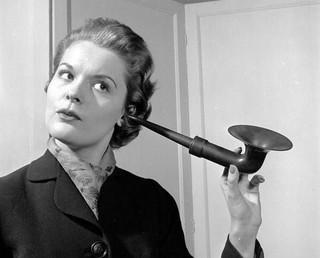
On Thursday, I went to visit one of my friends who lives in a skilled nursing center.  She has a number of chronic diseases that she's managing with help from the staff, so I usually feel as though her situation is somewhat under control. This week, however, I watched her struggle to manage her latest challenge.

About a month ago, she suffered hearing loss that appeared at the same time that she fell and hit her head.  I am not a doctor, and I am not a member of her family, so I don't have access to her medical records. And she has cognition problems that prevent her from reporting what her doctor and her adult children tell her about her own health.

Consequently, I don't know for sure why she can't hear or whether she will ever fully regain her hearing. But I did observe these new communication challenges that have emerged:

Wednesday, April 25, 2012

Elderspeak: Babytalk Directed at Older Adults

Photo by Neighborhood Centers
About a year after I started volunteering at a skilled nursing home, I observed a set of new teenaged volunteers who came to help with a craft at the monthly meeting of the Red Hat Society.  

I heard several of the volunteers speak slowly and loudly, using a sing-song voice.  In response, I saw many of the residents roll their eyes.   

Unfortunately, I had flashbacks to when I first started as a volunteer.   I had altered my speech inappropriately as well, hoping to be supportive but coming off as patronizing instead.


I have since learned to identify the features of elderspeak.  More importantly, I’ve learned to change my attitude.   

[Note: The links to this post were refreshed in January of 2018 to reflect current research.]

At its core, elderspeak communicates a condescending attitude.   And from that attitude the person’s language might demonstrate the following features of elderspeak:
  •  Speaking slowly
  •  Speaking loudly
  • Using a sing-song voice
  • Inflecting statements to sound like a question
  • Using the pronouns “we,” “us,” and “our” in place of “you.”: “How are we doing today?"
  • Using pet names such as “sweetheart,” “dearie,” or “honey"
  • Shortening sentences
  • Simplifying syntax (sentence structure)
  • Simplifying vocabulary
  • Repeating statements or questions
  • Answering questions for the older adult: “You would like your lunch now, wouldn’t you?”
  • In other ways talking for the older adult: “You are having a good time on the patio today, I see. And you have your pink sweater on, which you love. Right?”
  • Asking people questions that assume role loss, idleness and powerlessness such as “Who did you used to be?” “What did you used to do?” 

This post also appears at the fabulous blog Changing Aging.  

Friday, March 9, 2012

Coping with Illness

Photo by Judy Baxter
People of all ages and life situations are at risk for illness and injury.   But as we age we experience greater risk.  Whether the illness happens suddenly as with a fall or more slowly as with memory problems, the affected person and his or her family members must find methods for coping.

Course materials for the Nursing Learning Network identify the following tasks that ill people face:
  1. Change in body image
  2. Reality of their own mortality
  3. Coping with altered relationships with others
  4. Dealing with an altered level of dependency
  5. Adjusting to physiological changes
  6. Grieving for their losses, such as their former self or former lifestyle
  7. Fear of recurrent problems
  8. Illness occurs with other stressors, such as disrupted household routines, neglected or increased financial needs, and shifting workplace responsibilities

Thursday, January 26, 2012

Spirituality and Older Adults: Ask, Don’t Tell

Photo by Chineka
Because older adults often have to manage a number of losses as they age, they have the challenge and opportunity to turn to religion and to spirituality as methods for managing these losses.

Rates of depression among older adults are higher than many other age groups for this reason. At any age, a person would struggle with job loss, death of a spouse, or health troubles. But for the older adult, these types of losses often come in rapid succession, making it more difficult to manage.

However, older adults are not without resources. Some have well maintained support networks through family members and friends. Others have great self-awareness for what types of activities work as mood lifters, such as exercise or participating in hobbies, volunteer work or even paid work if they still have some type of employment. Many also have long-standing relationships with a community of faith and with practices that increase their spirituality.

Tuesday, January 3, 2012

Is It Dementia or Delirium?

Photo by Susan NYC
When I first started interacting with older adults with greater frequency as a student of gerontology, I was conflating a number of terms.

Senility, cognitive slowing, confusion, dementia, and Alzheimer’s are not interchangeable phenomena.

Senility is a dated term employed before contemporary medicine was able to diagnose more specific forms of cognitive changes.

Senility is a general term, one that lumps too many situations into one group. Using the label “senility” limits the observers’ understanding of the affected person’s limitations, capabilities and needs. Therefore, “senility” is a harmful term.

[Note: The purpose of this post is to raise awareness not to offer medical advice. If you have a concern about your health or the health of a loved one, please see a licensed medical professional.]

Cognitive slowing is a natural, age-related process. Everyone who ages will need more time and fewer distractions to perform various mental functions. If a person temporarily forgets the name of the lead actor in Gone with the Wind, this does not mean that person has Alzheimer’s Disease. In my 30s, I used to give three hour lectures in college literature courses without using lecture notes. Now I need to review names, dates and places that I used to recall immediately. This is especially true if I feel stress, if I am tired, or if I have distractions competing for my attention. Age-related cognitive changes include a degree of short-term memory problems, problems with word retrieval, word substitutions and slowing of executive planning and working memory.