Showing posts with label caregivers. Show all posts

Sunday, August 12, 2018

2018 MAIA Keynote and Plenary Speakers

MAIA 11th anniversary swag bag, program, and tee.
What Is MAIA?

For the last eleven years, the University of Southern Indiana in partnership with Southwestern Indiana Council on Aging & MORE! (the local Area Agency on Aging) has organized an inter-professional gerontology conference. This year, the conference ran August 9th and 10th with a pre-conference workshop on the 8th.


Located in Evansville, Indiana, this two-day event offers keynote and plenary speakers with national--if not international recognition. In addition, dozens of other presenters also offer great information about promoting wellness across the entire life span. 

The participants are local health care workers, university students, and members of the broader Tristate (IN, IL, KY) community.

Many healthcare professionals attending earn CME credits (continuing medical education), but a good portion of those present are not healthcare professionals; they are community members who are pro-active about their physical, financial, social, and emotional health.

Last week was the third time that I attended the Mid-America Institute on Aging and Wellness (MAIA). However, it was my first time serving as one of the organizers as a member of the Blue Shirts team. 

This gave me the opportunity to see the amount of work that goes on behind the scenes. I'm grateful for all that USI, SWIRCA, the sponsors, vendors, and all the presenters do in order to make this event informative and exhilarating. 

By looking at the program ahead of time, I had a chance to read more about all the presenters before they arrived. However, with six concurrent sessions happening three times a day for two days, it was impossible for me to attend all 36 sessions!

Let me first report some key details about the keynote and plenary speakers. (Details about the 2018 concurrent sessions are now available here.)

Wednesday, August 9, 2017

Teepa Snow at MAIA 2017

Snow explaining unmet needs at MAIA 2017.
I spent the bulk of today attending a pre-conference workshop on dementia care.

For the past year, I have been teaching gerontology classes part time in the College of Nursing and Heath Professions at University of Southern Indiana in Evansville, Indiana.

Each August, the university hosts an aging conference sponsored by local agencies and businesses that support healthy aging.

Read more about the Mid-American Institute on Aging & Wellness (MAIA) here.

The two-day conference is packed with speakers covering an array of topics about healthy aging and elder care.


Wednesday, November 23, 2016

Care Partner: An Emerging Term

Photo by Ian MacKenzie
Since 2010, I have been spending about twenty hours a week reading about the challenges and opportunities of aging.  Part of this time included reading a great deal about caregiving.

As I read materials from a variety of hard copy and electronic sources, I observed the following related terms for people who help meet needs for those struggling to complete activities of daily living (such as dressing) and instrumental activities of daily living (such as managing finances).

I observed these terms:

  • caregiver (dominate term in the literature for both paid employees and family members providing care)
  • caretaker (dwindling term, also used in another context as a house servant)
  • carer (Commonwealth term used by UK, Canada, Australia, etc.)
Then this year, I read a couple of books that used "care partner" to refer to those in supportive relationships with those living with dementia.  I was pleasantly surprised at the resulting the shift in emphasis.

Saturday, September 10, 2016

Connecting in the Land of Dementia: Book Review

Published 13 September 2016.
Living with dementia presents a host of challenges.

While there are a number of tips available for family members, the most transformative tips all come from this common ideal:

Show love and respect for people living with dementia while maintaining a meaningful connection.

Connecting in the Land of Dementiia: Creative Activities to Explore Together offers specific, practical suggestions for making this ideal a reality.

Author Deborah Shouse has an earlier book that shares the journey she and her mother took while finding ways to connect after her mother's diagnosis of dementia*.

[See this post about the terminology change favoring Neurocognitive Disorder over dementia.]

I've read more than two dozen books about family caregivers, and Shouse's is one of the most positive and hopeful paths through the caregiving partnership.

After reading Living in the Land of Dementia (2013), I was eager to see how she has extended her work in a second book.

[I received a copy of this book in exchange for a fair and honest review.]

In the intervening years, Shouse has met with a variety of people within the United States and beyond, all exploring creative ways to keep people with dementia engaged in meaningful relationships and activities. Her new book makes reference to many practitioners and researchers.

I had the opportunity to meet the author and her partner Ron when they did a performance art activity at a local library in south Central Kansas.  They are intelligent, creative, and caring people. Her book conveys these same virtues.

Monday, April 4, 2016

Somebody Stole My Iron: Book Review

Published 17 January 2014.
Supporting one parent through a chronic illness is challenging enough. Author Vicki Tapia chronicles her experience supporting her father through Parkinson's Disease and her mother through Alzheimer's Disease.

Her book is called Somebody Stole My Iron: A Family Memoir of Dementia, published 17 January 2014, available on Amazon.

Tapia's parents are having more and more trouble managing the basics. As the only child living locally to her parents, Tapia helps her parents through a couple of moves--from their home to assisted living to a skilled nursing center.

Most of her memoir discusses her mother's problems with memory, mobility, language and self-care.  Her father is a quiet man who rarely complains. Her mother is more outspoken, determined and demanding.

It's difficult to walk the line between respecting her mother's desire for independence and her mother's need for safety.

Tapia learns again and again that her mother's can present an illusion of capability that exceeds the reality.


Thursday, January 28, 2016

The Stranger in My Recliner: Book Review

Published 26 January 2016.
Fate brought Sophie into John McGettigan's path one day--quite literally.

When Sophie fell on the sidewalk in front of him, John recognized this small, octogenarian woman from their casual friendship as residents of the same town.  

At that time, Sophie had been living outside after losing permission to sleep in a basement of a meeting hall.  

Once John learned she was homeless, he drove Sophie home where his wife Doreen agreed that they should make a bed on the couch for Sophie. 

A night's refuge turned into a week, then a month. 

Somehow, Sophie ended up living with the McGettigans for over a year.  As a writer, Doreen worked through her thoughts and feelings about caring for Sophie by writing The Stranger in My Recliner


With a combination of pragmatics and tenderness, McGettigan worked to improve Sophie's physical, emotional and mental health.

[I received a copy of this book in exchange for a fair and honest review.]

Thursday, January 21, 2016

The Lie of "One and Done" Caregiving

Photo by RCC.
Aging is a gradual and dynamic process.

Many people do not realize this.

I say this because I have seen a lot of adult children hold onto an unrealistic view of aging.

Many adult children expect their parents to have full health until the week their parents move into a nursing home.

The adult child expects a "One and Done" type of intervention.

They expect that they will take one week off work to help transfer their parent from an independent home to a dependent nursing care environment.

One major change in health. One move. One intervention. One week. One and Done.

"One and Done" is NOT the norm.

For most older adults, aging is a dynamic experience.  The person's needs change frequently over time.


Sunday, September 27, 2015

I'll Be Me: Film Review

Released 24 October 2014.
After experiencing some difficulty with his memory for several years, Glen Campbell received a formal diagnosis of Alzheimer's Disease in 2011 at age 75.

About the same time as this diagnosis, Glen Campbell and his wife, Kim Campbell, invited a camera crew to film "behind the scenes."

The resulting documentary--Glen Campbell: I'll Be Me (2014)--is a tribute to this musical legend and an honest-yet-dignified view of the challenges of living with Alzheimer's Disease.

The documentary is filmed over about a year and a half; however, clips of performances over several decades are included as well.

The resulting documentary is a blend between a celebration Campbell's career and an exploration of how Alzheimer's affects a person's day-to-day life.

Thursday, August 6, 2015

The Theft of Memory: Book Review

Published 2 June 2015.
Jonathan Kozol, teacher, writer and activist for education reform, writes a compelling memoir about the years he and his father, Dr. Harry Kozol, spent together from 1994 to 2008.

The Theft of Memory: Losing My Father, One Day at a Time (2015) starts with the onset of Dr. Kozol's symptoms of Alzheimer's Disease and continue until his death at 102.

This dementia memoir distinguishes itself by being very academic in its approach.  

Both father and son are nationally recognized in their fields. Because this memoir reflects their professions, I suspect that readers will either love it or find it a bit too cerebral.
 

Thursday, July 2, 2015

Showering with Nana: Book Review

Published 30 April 2015.
Caregiving can push people to the edge of sanity.

Elder law attorney and family caregiver Cathy Sikorski takes a pro-active stance by pointing out the absurd things that happen in the life of a caregiver.

In her book Showering with Nana: Confessions of a Serial (killer) Caregiver, Sikorski documents what happened when her grandmother "Nana" stays for the six months that the author's mother was wintering in Florida.

[I received a copy of this book in exchange for an honest review.]

Because of various age-related challenges (memory changes, role loss and physical changes), Nana required constant attention--much as a toddler would.

Caregivers, despite some uncanny similarities, absolutely must treat older adults differently than they would a child.  Trying to do anything different not only is unethical, it's ineffective.

Or as Nana says, "You don't have to get testy, honey girl." 

The salient issue during the six months time frame of the memoir was the way Sikorski's 92-year-old Nana and two-year-old daughter, Rachel, combined forces to thwart the best laid plans for caregiving.


Friday, June 19, 2015

Caregiving for Three Weeks

Photo by MTSOfan.
I rarely blog about my teens. They prefer that I don't. However, I'm going to make an exception here. Let me apologize in advance for being a bit vague.

One of my kids broke a bone on June 11th while traveling down a water slide.  It was the collar bone, which will require about 3 to 5 weeks to heal.

When I mentioned this on my Facebook page, more than a dozen midlife friends reported having broken a collar bone that now healed.  I'm happy to hear all of these reports.

A few reported that decades later, they do have some issues.  Some have a little trouble sleeping on that side and reported feeling a little cold-weather-related pain.  These long-term affects seem very manageable.

Nevertheless, I find myself hovering. It's been a week since the fracture, and I'm still functioning as an extra pair of hands. The doctor's orders were "Keep that left side immobile."  OK!

I've read a great deal about caregiving, but I'm living it for the first time.


Sunday, May 24, 2015

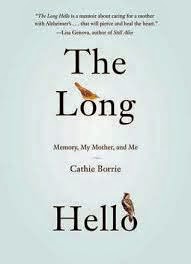
The Long Hello: Book Review

2nd Edition
Published 6 January 2015
All books are greater than the sum of their parts, but Cathie Borrie's The Long Hello: Memory, My Mother and Me really exceeds its boundaries in the most provoking ways.

I'm including her book in my list of memoirs about giving care to a family member with dementia.

However, the topics she covers and the genre she creates really differs from most books labeled "dementia memoirs."

Yes, Borrie details her relationship with her mother, Jo, over those seven years of caregiving.

Yes, like many other caregivers, she also reaches back to share memories from her mother's past, her own past and their shared experience.

Borrie is one of two children, and she's a child of divorce. Then her brother dies while still a teen. Borrie and her mother have sought for decades to survive these difficulties--even to thrive despite the sorrow, anger and pain inherent in these and other losses.

But Borrie writes a memoir in a way that does much, much more than preserve the past that she and her mother share.  Her mother's dementia sets the stage for Borrie to create a new relationship with her mother in the present. And while doing so, she creates a new person in herself.  


Friday, October 24, 2014

Chast's Graphic Novel: A Book Review

Published 6 May 2014.
Growing old has some great benefits. Frailty is not one of them.

New Yorker cartoonist Roz Chast focuses her talents on describing her parents' journey into late adulthood--their 90s.  And it's not pretty.

The title of her book actually defers potential readers: Can't We Talk About Something More Pleasant? (2014).

So why read a graphic novel about the challenges of supporting frail parents?

UPDATE: Chast won the 2014 National Book Critic Circle Award for the autobiography category for this book.

Even if you aren't going to support parents or a spouse through this process, you will have friends going through some of the things that Chast draws and narrates.

But you won't have the exact same journey. Chast is the only child of parents who lived for decades in the Flatbush section of Brooklyn.


Saturday, October 11, 2014

Class and Women Writers

Photo by Filip.
I spent over a decade in college studying English language and literature and then more time than that teaching undergraduates how to read, write, and think critically.

Now that I have left that career to be a gerontologist, I'm reading more books about aging, including a great deal of nonfiction about related topics of caregiving, living with an illness, late-life career changes, economic issues of aging, humor pieces, managing grief and gleaning wisdom and spiritual insight in late life.  

I try to read broadly on the topic of aging, but sometimes I discover big gaps in my reading selections.


Wednesday, October 8, 2014

Grey Gardens: 1975 Documentary

Big Edie & Little Edie
Photo by Slagheap.
For the last five years, I've been viewing and reviewing films that feature older adults.

For this reason, I have long had the 1975 documentary Grey Gardens in my "to be viewed" queue (along with 170+ others).

After being nudged by the bloggers at Dementia Mama Drama to see this Grey Gardens (1975), I finally moved this cult classic to the top of my queue.

The documentary shows a mother and daughter living in a decaying mansion in East Hampton, New York.

The film contains relevance for me because the 58-year-old daughter "Little Edie" serves as a caregiver for her 80-year-old mother "Big Edie."  (These are their ages during filming.)  Many posts I write are aimed at midlife adults who are supporting their older adult parents with age-related issues.

However, I am not sure how to respond to the documentary.

Little Edie. Photo by Slagheap.

Saturday, May 24, 2014

All Gone: Dementia Memoir with Recipes

Published September 27, 2012
I continue to read memoirs about caregivers supporting a family member with dementia.

I do so because memory changes affect each person uniquely.  And scientific studies of dementia don't do enough to explain the impact memory changes have on relationships and identity.

Most recently, I have read All Gone: A Memoir of My Mother with Refreshments (2012) by Alex Witchel, whose mother, Barbara, is living with vascular dementia, which may or may not have been the result of a 60 year smoking habit.

But with all other dementia memoirs, the book does not limit Barbara Witchel to a case study in dementia. She is not defined by this disease.

Instead, her daughter Witchel spends the majority of the time describing her mother's childhood, vocation, family relationships and personality.  She celebrates her mother while at the same time trying to support her in practical and emotional ways as the disease progresses.


Wednesday, March 26, 2014

Re-imagining Alz: Dancing with Rose

Published May 31, 2007.
No doubt, living with dementia is a challenge. Whether caused by Alzheimer's Disease, vascular dementia or another cognition-altering malady, memory problems make it difficult to function in the world, difficult to relate to others.

I have frequently heard caregivers recommend Lauren Kessler's book Dancing with Rose: Finding Life in the Land of Alzheimer's. I finally made the time to read her account of working in the memory care wing of a skilled nursing facility.

Trained as a university professor, Kessler decided to work a minimum-wage job as a certified nurse assistant (or resident assistant as she calls it). She chose to do this as a way to pay homage to her mother who spent her last few years living with dementia.


Monday, November 11, 2013

Special Exits: Book Review

Published September 2010
by Fantagraphic Books.
After seeing Special Exits on several lists for outstanding graphic novels, I decided to see how the author / illustrator Joyce Farmer tackled the subject of the growing frailty of her father and step-mother.

Farmer's graphic novel is semi-biographical, detailing the day-to-day challenges that a mature couple--Lars and Rachel--face as they experience greater and greater health challenges while living in their South Los Angeles home.  

Part of the novel's historical context includes Lars and Rachel having to manage during the 1992 Rodney King riots that took place in their neighborhood and surrounding area. 

Rachel's health declines first. She has trouble with her vision, her memory, and her mobility. She ends up living on the couch in the living room. Lars does his best to care for her, but he starts to wear down emotionally and physically. And Lars has some serious health problems himself that he masks for the majority of the novel.


Friday, October 4, 2013

Non-Medical Home Care

Photo by flossyflotsam.
When choosing to be a gerontologist, I imagined helping the Baby Boomers with their own aging process.

Boomers (born between 1964 and 1946) do not perceive themselves as older adults.

Because of the increases in life expectancy in developed countries, Boomers still know a lot of people who are decades older than they are.

Consequently, most Boomers--even the trailblazers who are now 67--see themselves as inhabiting the life stage of "extended midlife."

Many from the Boomer generation aren't ready to claim being older adults because they are still offering support for their own parents.

In 2010, MetLife reports that nearly 10 million people 50 plus care for an aging parent. Furthermore, their study states:

Friday, September 27, 2013

Adding Care to Senior Housing

Photo by Kotomi_.
In decades prior, older adults often lacked options for aging with support. Many either stayed too long in their own homes without adequate services, or they moved too soon  into a skilled nursing facility.

Older adults today have more options for where and how they age:

Types of Housing
  • Long-established Home (with or without modifications for aging in place)
  • Relative's Home
  • Active Adult Community
  • Senior Apartments (some are government subsidized)
  • Independent Living Communities
  • Assisted Living Communities
  • Skilled Nursing Facilities
  • Continuing Care Retirement Community (2 or more levels of care under one roof)
Or they might be in a temporary situation after an acute illness:
  • Subacute "Step-down" Facility 
  • Long-term Acute Care Hospital
Some of these choices might be unavailable or difficult to acquire due to constraints on finances, family availability, geographic location, health, or limited supply / vacancies.

Services Added to One of the Above Settings